














|
|
|
|
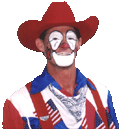
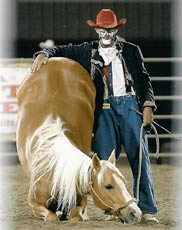
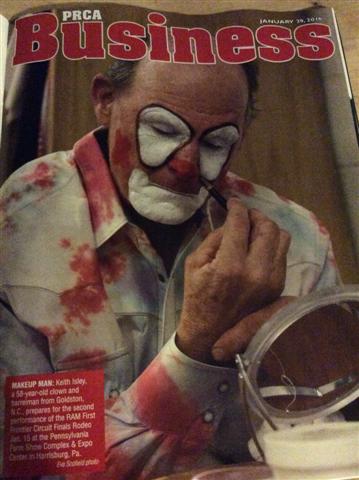
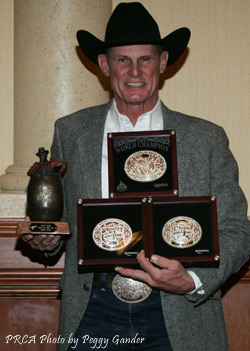
For the second straight year, Keith Isley swept the Coors Man in the Can award, Comedy Act of the Year and Clown of the Year at the annual PRCA Awards Banquet, Dec. 1 at the South Point Hotel, Casino & Spa in Las Vegas. Isley, from Goldston, N.C., also was selected as Coors Man in the Can in 2006.
|
|
|
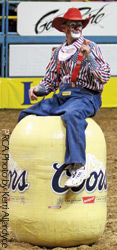
By PSN Editor Neal Reid One of the most popular and entertaining characters in the arena at PRCA rodeos across the country is the barrelman. He helps entertain the crowd during breaks and lulls in action, often verbally jousts with announcers – in a playful manner, of course – and helps protect bull riders from the massive beasts they are trying to ride for eight seconds. They have been a fixture at rodeos for decades, an important part of the rodeo landscape from the start. In 1984, the Coors Brewing Company – now Molson-Coors Brewing Company – recognized the importance of the barrelmen and the chance to have its logo in the arena at hundreds of PRCA rodeos, sponsoring the Coors Man in the Can program. The program provides barrelmen with stability, support and guidelines for performance in the arena and has outreach at more than 700 performances at more than 300 PRCA rodeos each year. Coors dedicates more than $100,000 to the program each year, $10,000 of which goes to the barrelman who is selected as the Coors Man in the Can at the PRCA Awards Banquet in Las Vegas each December. This year’s winner was Keith Isley of Goldston, N.C. It was his second consecutive win and third overall. He also won the award in 2006.
Each barrelman who participates in the program receives $60 per performance in which he rolls a barrel into the arena sporting the Coors logo, and each of the five finalists for Coors Man in the Can receive a bonus at the end of the year. This year’s finalists along with Isley were, Troy Lerwill, Robbie Hodges, Mark Swingler and John Harrison. The financial commitment by Coors, the PRCA’s official beer since 1987, makes it easier for barrelmen to get down the road each year and make a living. “I think it’s a great program,” Isley said. “I think it’s the best program in rodeo, as far as the barrelmen go. It gives you more of an incentive for keeping your barrel looking good, and it makes you be more of a professional since you are going to be judged at some point.” Barrelmen are judged in three categories – barrel appearance, appearance and presentation in the arena and assistance in bull riding and timing – by a panel consisting of the top 100 bull riders in the PRCA World Standings; all PRCA judges and Pro Officials; all PRCA announcers and timers; and all PRCA bullfighters who are not also in the Coors Man in the Can program as barrelmen. In addition to the whopping $10,000 check, the Coors Man in the Can award winner receives a Montana Silversmiths buckle, a Tony Chytka replica bronze of a Coors barrelman and his name on the list of award winners in the ProRodeo Hall of Fame and Museum of the American Cowboy in Colorado Springs, Colo. Not a bad haul at all. “I said on the awards stage that, since the award pays $10,000, Pete Coors and I were now about even,” Isley quipped. “I had been nominated in the top five for quite a few years, and to win that $10,000 is quite an honor. It makes you appreciate the program and makes you feel like you’re doing something right. “To get $10,000 in December when there aren’t a lot of rodeos going on, it sure does come in handy. I’m just glad they can’t cash the check for us in Vegas!” The program was created when a group of men that included former PRCA Chairman of the Board Tom Feller approached Coors in 1983 to talk about the beer company sponsoring barrelmen. Coors agreed that there was a need for the program and agreed to be its title sponsor, and the rest is history. “The idea was born out of the Wrangler Bullfights, and until that point, a barrelman was just a clown out there,” said Feller, who won the first Coors Man in the Can award in 1984 and then again in 1987. “With the introduction of the Wrangler Bullfights, it took on a whole new dimension. Coors wanted more visibility in rodeo, and the barrelmen wanted more visibility. So, it just kind of evolved. “It’s definitely been a good visibility and marketing tool for Coors through the years, and it’s also helped the barrelmen add some extra income. It’s obviously proven to be a very strong marketing program, because they’ve stuck with it for 26 years.” Barrelmen who participate in the program take pride in it and enjoy having the support from Coors. “I’m honored to be part of the Coors Man in the Can program,” said Hodges, who worked the barrel at his first Wrangler National Finals Rodeo earlier this month. “If I was ever voted as the Coors Man in the Can, that would be the honor of a lifetime, because you’re being rewarded for doing what you’re supposed to do. “Being nominated for the Coors Man in the Can is the best honor a barrelman can receive, because that’s voted on by the people you work with closest all year. It’s a great program.” Nowadays, the Coors logo can be found in the arena on gold barrels at PRCA rodeos across the country, and the program has never been stronger. “While I have never been a beer drinker, I was always proud to be part of the program and proud to have my barrel looking good,” Feller said. “It’s by far the best thing that’s ever happened to the barrelmen.” (Note: This article was written by and courtesy of ProRodeo Sports News Editor Neal Reid. Special thanks to Reid and Donna Keffeler. ProRodeo.com’s Johnna Espinoza also contributed to the story.) |
|
|
|
|
|
|
|
|
|
|
PRCA AWARDS DINNER
|
|
|
While many familiar faces were recognized, Keith Isley had a particularly special night. In addition to his fourth consecutive Clown of the Year award, he also won his second Coors Man in the Can award and third Comedy Act of the Year honor. The North Carolina native was quick with a joke as he stepped onto the awards stage to receive his Coors award, the first he received that evening. "The Coors program, for the barrelmen, is undoubtedly the best program in Pro Rodeo," Isley said." (To win) $10,.000, the way I look at it, me and Coors are even now." Isley thanked Wrangler, Justin Boots and, in particular, the Justin Sports Medicine Team, and he also lauded the merits of smaller rodeos - mentioned the PRCA rodeo in Woodward, Okla., by name - as being the embodiment of everything the PRCA represents. After receiving his Clown of the Year award, Isley took time to reflect on the recognition he was receiving. "I am undoubtedly the luckiest person that has ever come into the city limits of Las Vegas," Isley said. "My career in the PRCA started in late 1994, 1995. In 1995, I had maybe five rodeos, from there it mushroomed. "In 1999, on Thursday night before the rodeo, was the highlight of my career- when I won Specialty Act of the Year. This year, winning these awards and being able to work the National Finals Rodeo with the best of the best, has probably taken over that spot." As an emotional Boyd Polhamus talked with program host Wayne Brooks after accepting his third consecutive Announcer of the Year award, he spoke of the joy that comes with calling is family after receiving the award and told the crowd how he hopes some of his peers will be able to experience that joy in future years. "There's a part of me that wants Andy Stewart's mom and dad to get the call I get to make tonight," Polhamus said. "There's a part of me that wants Roger Mooney's mom and dad to get the call I get to make tonight. This is your award to give, and you've spoiled me. I'm not ungrateful; I love you for it. But there's other people who deserve this, too, so don't hesitate to share it with them." Many of the night's winners had made the trip to the awards podium in previous years, including Secretary of the Year Haley Schneeberger (third consecutive), Dress Act of the Year John Payne (second consecutive) and Stock Contractor of the Year Stance Smith (sixth consecutive). Each of the four committee awards were also repeat winners. The Rooftop Rodeo in Estes Park, Colo., won its fourth small outdoor committee award, and the Deadwood (S.D.) Days of '76 Rodeo remained the only committee to ever win the medium rodeo award in the prize's sixth year. The San Antonio Stock Show & Rodeo and the Cheyenne (Wyo.) Frontier Days took home the awards for best large indoor and outdoor rodeos, respectively. Cory Wall received a rousing ovation as he walked to the stage to receive his first Bullfighter of the Year award, as did the Calgary Stampede and the Farm City Pro Rodeo of Hermiston, Ore., who received the Remuda awards for the best pen of bucking horses. Russel Erben of the Comal County Fair & Rodeo (New Braunfels, Texas) was selected as Justin Committeeman of the Year. The PRCA Media Department honored three men for their outstanding work in rodeo journalism, Dudley Barker of Stephenville, Texas, received the photographer's award, Joe Kusek, of the Billings (Mont.) Gazette received his second print journalism award and Steve Kenyon of ProRodeoLive.com received the honor for the broadcast/Internet journalism. A special halter was also given by PRCA Media to Flying 5 Rodeo's Spring Planting the 2009 USST/PRCA Saddle Bronc Horse of the Year.
|
|
|
|
|
|
|
|
Pro Rodeo Sports News.... Kristen M White |
|
|
Keith Isley, the 2006 PRCA Clown of the Year and Coors Man in the Can winner has his wife of 19 years, Melanie, to thank for starting him on the road to success. She was a trick rider when they married, and he became a trick rider, too. Even though she quit riding in 1991, Isley carried on with it, and "that trick riding act got me where I am today." How did you become a rodeo
clown? What is the toughest thing about being a clown? What misconceptions do you think the general public has about rodeo
clowns? If you weren't a rodeo clown,
what would you do? What's your favorite part about
the rodeo world? How hard is it to be funny all the time, and was it learned or
natural? What's your favorite way to spend a vacation? What do you do in your spare time? -- Kristen M White (5/23/07)
Thursday, November 30, 2006 ESPN.com LAS VEGAS — Keith Isley has spent years
impressing audiences around North America with his array of
talents, ranging from trick riding and comedy acts to work as a
clown and barrelman. Isley, a PRCA member since 1994, had previously
been honored six times as the PRCA's top specialty act — the
last coming in 2004 in the comedy category — but never had the
resident of Reidsville, N.C., enjoyed such a night of prolific
success. "This is unbelievable," Isley said.
"When I saw who I was nominated against, I picked out the
winners and they definitely weren't me. I'm just a small part of a
large group of people who make things work." Each year, before the cowboys and cowgirls compete
in the arena at the Wrangler National Finals Rodeo, the top
contract personnel — a wide variety of mainly behind-the-scenes
individuals who contribute to rodeo's success — as well as
animal athletes are honored and toasted as the best of their
craft. For years, many have recognized Bob Tallman as the
sport's top announcer, and for good reason. Tallman (Poolville,
Texas) was inducted into the ProRodeo Hall of Fame in 2004 and
this week is calling the action at his 12th consecutive Wrangler
NFR and 20th overall, both event records. He added to his
impressive and legendary resume on Wednesday by being named PRCA
Announcer of the Year for the eighth time. Another multiple-time winner and fellow Hall of
Famer is Mildred Farris (Addington, Okla.). Farris, part of the
first husband-wife team to enter the ProRodeo Hall together when
she and John were inducted earlier this year, was named PRCA
Secretary of the Year for the ninth time. For the third year in a row and record eighth time overall, the
Cheyenne (Wyo.) Frontier Days Rodeo earned top accolades as the
Large Outdoor Rodeo Committee of the Year. Other recipients from Wednesday's annual Awards Banquet were: Bullfighter of the Year: Joe Baumgartner (Red Bluff, Calif.);
|
|
|
|
|
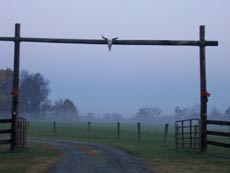
Welcome to Isley Farm |
|
|
|
|
|
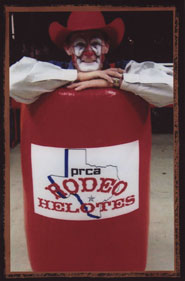
Keith in Helotes, TX |
|
|
|
|
|
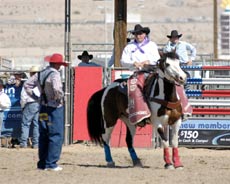
Keith & Scott in Laughlin NV |
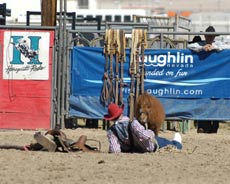
Punkin & Keith in Laughlin, NV |
|
|
|
|
Keith & Cooter in Laughlin NV |
|
|
Laughlin photos by Rich Ruef Photos |
|
|
|
|
|
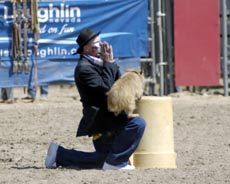
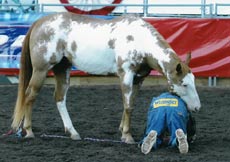
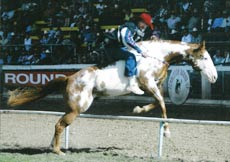
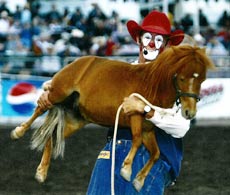
Keith performing at Bremerton, WA |
Keith performing at the Pendleton Round Up |
|
|
|
|
Keith performing at Bremerton, WA |
|
|
Photos by Hoot Creek Photography |
|
 “I take great pride in the Coors Man in the Can program,” said Pete Coors, chairman, Molson-Coors Brewing Company. “A tradition since 1984, it’s one of the longest-running rodeo programs in the brand’s history. You’ll never meet a more loyal group of guys, and I truly appreciate everything they do for the sport of rodeo and the Banquet brand.”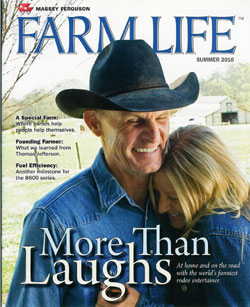
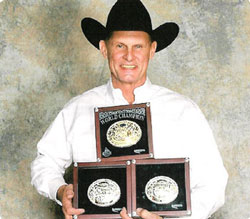 Isley
pulls three-award sweep on the night before the start of the
Wrangler National Finals Rodeo, the PRCA took time to honor the
sport's top personnel and rodeo committees with its annual awards
dinner Dec. 2 at the South Point Hotel, Casino & Spa.
Isley
pulls three-award sweep on the night before the start of the
Wrangler National Finals Rodeo, the PRCA took time to honor the
sport's top personnel and rodeo committees with its annual awards
dinner Dec. 2 at the South Point Hotel, Casino & Spa.
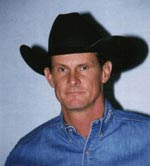 On
Wednesday night at the PRCA's annual Contract Awards Banquet,
Isley's efforts were recognized on three different occasions,
earning honors as the Coors Man in the Can, PRCA Clown of the Year
and Specialty Dress Act of the Year during ceremonies at the South
Point Hotel and Casino in Las Vegas.
On
Wednesday night at the PRCA's annual Contract Awards Banquet,
Isley's efforts were recognized on three different occasions,
earning honors as the Coors Man in the Can, PRCA Clown of the Year
and Specialty Dress Act of the Year during ceremonies at the South
Point Hotel and Casino in Las Vegas.